Reading time: 11 minutes
B2B content distribution works best when each channel has a role. LinkedIn gives reach, the newsletter and email keep in touch with people who know the brand, and communities bring conversation. So define what to publish, the cadence and the UTM for each channel. This guide also covers US and EU email rules.
In short
- Give each channel a role: LinkedIn for reach, the newsletter and email for recurring contact, and communities for conversation.
- We suggest the cadence your team can sustain for three months, and the open numbers are only a reference.
- Email to business contacts is regulated: CAN-SPAM applies in the US, and the ePrivacy Directive and GDPR apply in the EU.
- Every B2B content distribution link gets a lowercase UTM with fixed values, or the visit may land in Direct in GA4.
- In the newsletter, watch clicks and sessions, not the open rate.
Which channels are part of B2B content distribution?
Four channels are part of B2B content distribution: LinkedIn, newsletter, nurture email and communities. The first two have open usage data, while the other two depend more on your market. So before you build the plan, see what one survey shows.
- CMI, B2B, mostly North America: the Content Marketing Institute surveyed 1,015 B2B marketing professionals from June to August 2025. The page lists LinkedIn (76%), email newsletters (54%) and speaking events and webinars (52%) as the three most effective channels for thought leadership content. It does not say the base of those percentages. However, CMI sells education and events, and Storyblok, which sells a content management system, sponsored the study.
The survey has a commercial interest and does not say which channel generates more sales. So treat it as a snapshot of usage and test with your own audience. For communities, we found no open study that measures the return.
What role does each channel play in B2B content distribution?
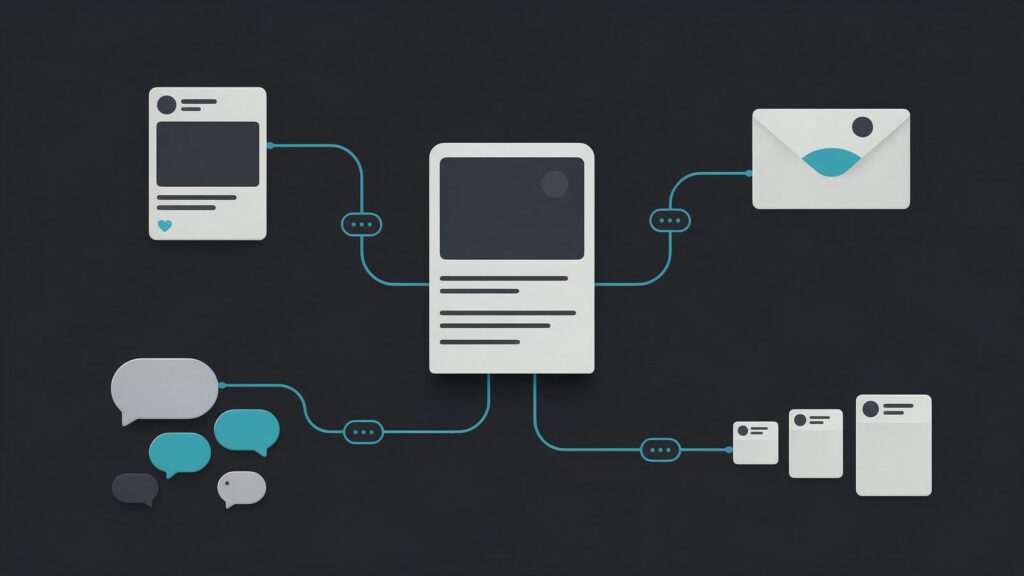
We suggest giving each channel a role, so the plan does not become four versions of the same text:
- LinkedIn: reach and authority, since it reaches the network and followers of the specialist and the page.
- Newsletter: recurring contact, since only people who asked for it receive it.
- Nurture email: the next step for the lead, that is, for people who downloaded a lead magnet.
- Communities: conversation and questions among the members of the group.
The roles are our suggestion. Also, the guide to B2B content marketing shows what to produce before you distribute, and the content marketing pillar gives the general map.
What should you publish in each B2B content distribution channel?
Publish in each channel the version that fits it, not the whole article. The article stays on the site, but each channel carries an excerpt with a link. This way, the reader picks the entry point, and measurement stays per channel.
LinkedIn: post, article or newsletter?
Use the post for a short answer with the link, the article for the full analysis and the newsletter for a series. For the editor step by step, see the guide to publishing an article on LinkedIn, which also covers getting AI to cite those texts.
On the LinkedIn newsletter, according to the platform’s help page, connections and followers get an invitation to subscribe when the first issue goes out. After that, each issue sends subscribers a notification or email. The help page also says the most engaging newsletters cover a unique topic, consistently.
Your own newsletter: what goes in each issue?
We suggest one issue with one theme, three or four short blocks and one main link. The blocks can be the summary of the new article, a data point or template, and the answer to a reader’s question. Each block must deliver its idea alone, because not every reader clicks. To gain subscribers, put the invitation in the article’s lead magnet.
Gmail’s sender guidelines apply to personal Gmail accounts, so they call for some care:
- Consent: confirm that the person agreed to receive your emails, confirm the address before signing them up, and never buy lists.
- Authentication: since February 1, 2024, every sender needs SPF or DKIM, and the spam rate in Postmaster Tools must stay below 0.3%.
- Unsubscribing: above 5,000 messages a day to Gmail, marketing emails need one-click unsubscribe, along with SPF, DKIM and DMARC.
- Clean list: Google suggests considering unsubscribing people who do not open or read your messages.
Other providers have their own rules, and we only read Gmail’s.
Which email rules apply to a B2B newsletter?
Email to business contacts is regulated too. In the US, the FTC’s CAN-SPAM guide says the law covers all commercial email and makes no exception for B2B messages. The guide centers on opt-out rather than prior consent. Each message needs accurate header information, an honest subject line, a clear ad disclosure and a valid postal address. It also needs a clear opt-out, which must work for at least 30 days and be honored within 10 business days, with no fee. If a vendor sends for you, the responsibility stays with you. The guide lists penalties of up to $53,088 per violating email, adjusted for inflation.
In the EU, the rules differ. Under Article 13 of the ePrivacy Directive, email direct marketing generally needs the recipient’s prior consent. The exception covers customers whose address you got during a sale, for your own similar products. Even then, you must offer an easy, free way to object at collection and in every message. The sender cannot hide its identity and must give a valid address for stopping the messages. For subscribers that are companies, the directive only asks each Member State to protect their legitimate interests, so B2B rules can vary by country.
The GDPR also applies when the address points to a person (Article 4(1)). Processing needs a legal basis, such as consent or legitimate interests (Article 6(1)). Consent must be as easy to withdraw as to give (Article 7(3)). A person can object to direct marketing at any time (Article 21(2)), and then you must stop (Article 21(3)). This is not legal advice, so validate your setup with a lawyer who knows your target markets.
Nurture email: what is the lead’s next step?
In B2B content distribution by email, people who downloaded a lead magnet receive a short sequence with the next article on the same track. We suggest three emails in two weeks, each with one link and one question that is easy to answer.
Communities: how do you share without being spammy?
Take part before you post, because content distribution in communities depends on trust. Rule 2 of the Reddit rules asks for authentic participation in communities where you have a personal interest, and it bans spam. Read each group’s own rules before you write.
Our suggestion is to answer in the comment itself, add the link only when it goes deeper, and say the content is yours. This way, the link becomes help, not advertising.
What cadence should you follow in each channel?
Follow the cadence your team can sustain for three months (our suggestion). We found no recent open study, with a published method, on how often B2B teams send newsletters. LinkedIn’s newsletter setup asks how often you plan to publish, so pick a rhythm before you launch. Two limits apply to every channel by email: honor each opt-out within 10 business days (the US CAN-SPAM rule), and keep the spam rate below 0.3% in Gmail’s Postmaster Tools.
- LinkedIn: one post per new article and one repurposed post per week, but without repeating the same text.
- Newsletter: every two weeks or monthly, on the same day and time, and say so on the signup form.
- Nurture email: three emails in two weeks per lead magnet, and stop the sequence when the person replies.
- Communities: two to three contributions per week, because the goal is to talk, with at most one in four carrying a link.
All the cadences in the list are our suggestion, with no study behind them. So start with the smallest rhythm and only increase it if the team can handle it. After all, a rhythm that fails in week four hurts more than a smaller one that holds.
How do you measure each B2B content distribution channel in GA4?
Tag every link with a UTM, because that is how GA4 knows where each session came from. According to the Google Analytics help page, the values show up in the traffic acquisition report. Also, utm_source, utm_medium and utm_campaign should always be present.
Without a UTM, however, the visit may land in Direct. The help page on (direct)/(none) lists links without a UTM, redirects and shorteners such as bit.ly as causes.
| Where the link is | utm_source | utm_medium | utm_content |
|---|---|---|---|
| Your own newsletter | newsletter | main-link | |
| Nurture email | nurture | email-1 | |
| LinkedIn post | social | post-1 | |
| LinkedIn newsletter | social | linkedin-newsletter | |
| Community | community-name | referral | answer |
In every row, utm_campaign carries the name of the article or lead magnet, such as lead-magnet-guide. A complete newsletter link looks like this: https://yoursite.com/blog/article/?utm_source=newsletter&utm_medium=email&utm_campaign=lead-magnet-guide&utm_content=main-link. The values in the table are our model, not a Google rule.
With these values, the medium decides the channel. In the default channel definitions, a source or medium of email leads to the Email channel. The social medium leads to Organic Social, and the referral medium leads to Referral. When no rule matches, GA4 uses Unassigned. The UTM help page asks for lowercase names, because values are case-sensitive. So keep the list in one spreadsheet.
To follow the session through to the lead, see how to measure blog leads with UTMs, events and a form.
Which numbers should you watch in each channel?
In B2B content distribution, look in two places: the platform, to compare pieces, and GA4, to compare channels. The two will not match, but that is normal. In the LinkedIn post analytics, for example, “visits to links” include repeat clicks, and the page warns that the numbers are estimates.
- LinkedIn: on the platform, impressions, reactions and visits to links; in GA4, the linkedin / social sessions. However, repeat clicks count in the total.
- LinkedIn newsletter: email sends and the open rate of the issue, which is an estimate; in GA4, the sessions of the issue’s UTM.
- Your own newsletter: deliveries, clicks and unsubscribes in the sending tool; in GA4, the newsletter / email sessions. The open rate, however, is unreliable, as we explain below.
- Nurture email: clicks per email and, in GA4, sessions and lead magnet submissions per campaign, but the sample is usually small.
- Communities: replies and reactions in the group and, in GA4, referral sessions per community. Since the volume is low, add the “how did you hear about us” question.
On opens, Apple says that Mail Privacy Protection, when turned on for the iPhone, stops the sender from seeing whether the email was opened. It does not extend to links. In our reading, the open rate becomes unreliable. So prefer clicks and sessions.
Some people read, forget and type the address later. That visit lands in Direct. So ask how the person heard about the company at the first contact. Also, we found no open benchmark of clicks or opens for B2B email with a published method. So compare each channel with your own history from the last four issues.
How do you build a B2B content distribution plan for one article?
Build one row per action, with date, channel, text, UTM and metric. The table below is a four-week model (our suggestion), so copy it into a spreadsheet and change the dates. It works as a B2B content distribution plan for each new article.
| When | Channel | What to publish | utm_content | What to watch |
|---|---|---|---|---|
| Day 1 | Site | Article live, with the lead magnet invitation | no UTM | Article sessions |
| Day 1 | Post with the short answer and the link | post-1 | Link visits and sessions | |
| Day 3 | Community | Reply to a real question | answer | Referral sessions |
| Next issue | Newsletter | Block with the summary and the link | main-link | Clicks and sessions |
| Day 8 | A data point or template from the article, in a new post | post-2 | Link visits and sessions | |
| Day 14 | Nurture email | The article for people who downloaded the lead magnet | email-1 | Clicks and lead magnet submissions |
| Day 28 | Review | Total by utm_campaign in GA4 | no UTM | Sessions and leads per channel |
After four weeks, compare the channels by utm_campaign in GA4. Then keep the two that brought the most qualified sessions and adjust the others (our suggestion). This way, B2B content distribution follows a number, not the team’s feeling.
Main sources
- Content Marketing Institute, B2B Content and Marketing Trends: Insights for 2026 (2025).
- FTC, CAN-SPAM Act: A Compliance Guide for Business (2024).
- EUR-Lex, Directive 2002/58/EC (ePrivacy), Article 13.
- EUR-Lex, Regulation (EU) 2016/679 (GDPR).
- Gmail, email sender guidelines (2026).
- LinkedIn, help page on managing a newsletter (2026).
- Apple, Mail Privacy Protection on iPhone (2026).
- Google Analytics, campaign data collection with UTMs (2026).