
Reading time: 12 minutes
GEO for consultants means making AI know who you are, what you do and for whom, with the same data on your site, on LinkedIn and in third-party sources. So an independent consultant starts GEO with one profile sheet that holds this data. Independent service providers follow the same steps.
In short
- In a Muck Rack study, about 84% of AI citations came from earned media. Owned and paid content, however, made up about 16%.
- According to Google, unique and useful content will likely affect presence in generative AI more than any other suggestion in its guide.
- Google Business Profile asks for a place customers can visit or service at the customer’s address. A virtual mailing office does not qualify.
- Finally, to measure without a paid tool, run 10 customer questions, 3 times each, and note whether your name and the cited sources appear.
How does AI choose who to recommend in GEO for consultants?
In GEO for consultants, the first question is how AI chooses who to recommend. However, we know of no complete public rule. What exists are studies on the sources that AI answers cite. They include the company’s site, its profiles and what third parties say.
Muck Rack sells a platform for public relations teams. It analyzed more than 25 million links cited by ChatGPT, Claude and Gemini. About 84% came from earned media, that is, sources that are neither paid nor owned by the company, such as journalism, encyclopedias and social platforms like LinkedIn. On the other hand, owned and paid content made up about 16%. It is from May 2026, used consumer questions across 17 industries, not questions about hiring a consultant, and does not say the country of the questions.
According to the Google guide to generative AI, unique and useful content will likely affect presence in generative AI, in the long run, more than any other suggestion in it. Google also asks for a unique point of view, with the experience only you can bring. So an independent consultant doing GEO has material of their own: the method and the cases.
We found no open study, with a published method, on which sources AI uses to recommend independent consultants or freelancers. The closest is a Temso report on consulting firms, from a vendor that sells AI visibility tools. It covers 26,191 responses in 12 countries, including the United States, from July to September 2026. LinkedIn is among the five most cited domains for Microsoft Copilot, and Clutch for Copilot and Gemini. It counts citations of firms, not recommendations of people, so read it as a hint. New to the term? Start with what GEO is.
What does your site need to say in GEO for independent consultants?
In GEO for consultants, the site must say, in visible text, who the professional is, what they do, for whom, where they work and how to hire them. Two pages already help: one for services and one about you. According to Google, it should also be clear who created the content, with a byline that leads to more information about the author.
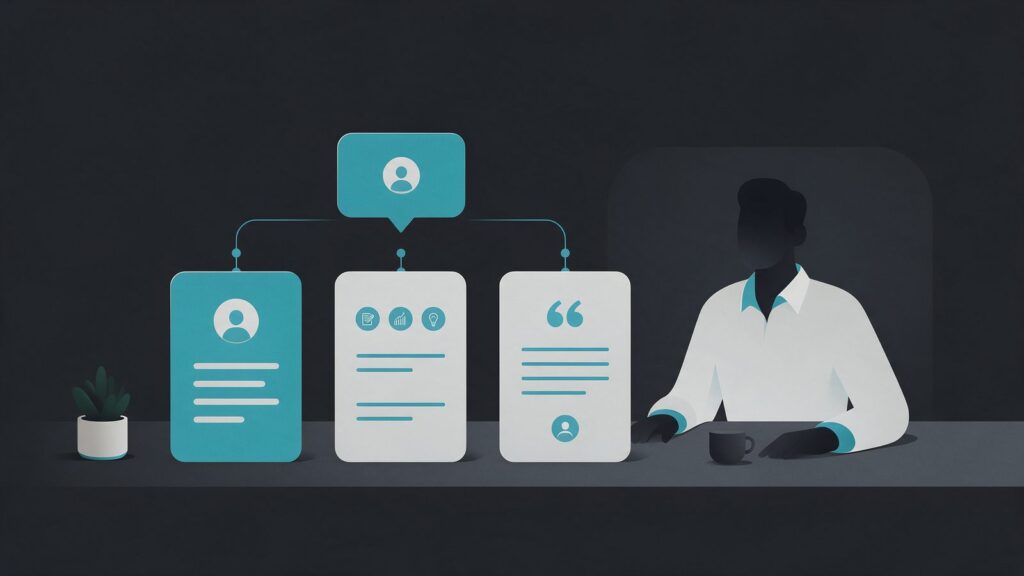
A professional profile sheet with seven fields
First, build one profile sheet and copy from it to every place. This way, an independent consultant doing GEO avoids different data on each profile.
- Professional name: always written the same on the site, on LinkedIn and on the Google profile.
- Opening sentence: what you do, for whom, where and since when.
- Services: each one with scope, audience and how the work starts.
- Method: the steps of your work, in plain language.
- Training and registration: degrees and professional registration number, if the profession requires one.
- Proof: approved case studies and testimonials.
- Contact: email, city and how to hire you.
For the page about you, the eight-block About us page template also works for people who work alone, because you just swap the company for your name.
The text only you can write
Google’s generative AI guide also separates generic content, such as “7 Tips for First-Time Homebuyers”, from content with the view of someone who has experience. So an independent consultant should write about real decisions in their work, such as what they ask the client before starting or the mistakes they see in the first month.
Never invent a credential, name or photo. After all, Google’s page on helpful content calls AI-generated headshots, made-up names and false credentials deceptive authorship. Finally, the generative AI guide says there is no special schema.org markup for it, so visible text comes first.
How do you use LinkedIn and your Google profile in GEO for consultants?
In GEO for consultants, LinkedIn and the Google profile repeat the sheet from your site. LinkedIn suits almost every professional, but Google Business Profile only applies to those who work at a place or at the customer’s address. So, on both, name, service and city must match the site.
LinkedIn: public profile and services page
According to LinkedIn Help, your public profile appears when someone searches your name on search engines such as Google and Bing, and you choose which sections are visible. However, search engines can take weeks or months to detect changes. So, for an independent consultant, GEO on LinkedIn starts with the public profile, with the sheet’s opening sentence in the headline and in “About”.
Next, LinkedIn lets you create a services page from your personal profile. It works through requests and proposals, but some features require a paid subscription. The help page also says the provider can invite the client to write a review. The help page does not say where the feature is available. So check whether it appears on your account and which parts need a paid plan.
Google Business Profile: who can have one
The Business Profile guidelines say a business can have a profile if it has a place for customers to visit or if it serves customers at their address. However, a virtual office, only a mailing address, does not qualify. Google names doctors, dentists, lawyers, financial planners, and insurance or real estate agents as individual practitioners, who must work in a public-facing role and be reachable at the verified location during stated hours. The list does not mention other kinds of consultants. Finally, the name must be the real one, the same as on the site.
So independent service providers who work only online should check these rules before creating a profile. For those who fit, Google’s generative AI guide says Business Profiles can help services be visible in AI responses. Meanwhile, the guide to GEO for local business shows what AI uses in searches with a city.
How do you use case studies and testimonials with approval in GEO for consultants?
Show case studies and testimonials only with the client’s written approval, preferably specific to name, photo and text. Without approval, tell the case without naming the client. In GEO for consultants, a testimonial gives AI and future clients third-party proof of your work, but none of your text should promise results.
- Ask before publishing: show the client the final text and record the approval in writing.
- Tell the case in three parts: the problem, what was done and the result, with the period of the number.
- Use only numbers the client confirms: with no number, describe what changed.
- Ask everyone for a review: never offer a discount or gift in return. The Google Maps policy does not allow incentives for reviews.
The guide to case studies explains how to write the case. Independent service providers who are just starting, for example, can show their method, the questions they answer and interviews with other experts.
What do FTC rules say about testimonials?
In the US, the FTC’s rule on consumer reviews and testimonials, in effect since October 21, 2024, targets fake or false reviews. The FTC says a business can be liable if it writes fake reviews or buys reviews it knew or should have known were false. So never write a testimonial for a client who did not give it.
The same page says review incentives are not banned, but cannot require a particular sentiment. Google’s policy is stricter, so follow it on Google. The FTC’s Endorsement Guides FAQ adds that a payment or free product tied to an endorsement usually needs disclosure. This guide is not legal advice.
Which third-party sources help GEO for consultants?
In GEO for consultants, the most accessible third-party sources are interviews, podcasts, signed articles, talks with an event page, and industry directories or associations. In all of them, write your name, role and specialty as on your site, so AI finds the same description in several places.
Avoid forced mentions, because Google says seeking inauthentic mentions across the web is not as helpful as it might seem. At Muck Rack, by the way, paid and advertorial content made up only 0.3% of citations. Here is where an independent consultant can start in GEO:
- Signed article: publish on LinkedIn or in an industry outlet, with the same byline as your site.
- Interview as a guest: offer journalists and industry podcasts a topic with your own data or point of view.
- Directories and marketplaces: join only those that fit your industry, such as Clutch for service firms or a freelance marketplace like Upwork, and check that the data matches the sheet. Clutch’s help page covers company profiles and does not say whether individuals can list, so check first.
To find the sources in your niche, note the domains AI cites in the measurement questions. These choices are our recommendations, not study results.
What questions do customers ask AI about independent service providers?
In GEO for consultants, customers ask in four ways: who to hire, how to solve a problem, how to compare options and whether a name is trustworthy. Each type needs a different page or profile from the independent consultant. However, the examples below are ours, not search data.
| Question type | Example | Where to answer |
|---|---|---|
| Who to hire | “logistics consultant for a small manufacturer in Columbus, Ohio” | Service page and profiles |
| Problem | “how to reduce delivery time in my e-commerce” | Article or FAQ on the site |
| Comparison | “hire a consultancy or an employee for finances” | Article with criteria |
| Trust | “Is [your name] trustworthy?” | Page about you, case studies and reviews |
Take the real questions from what clients asked in the first conversation, before closing. If you do not publish prices, explain what factors they depend on. Finally, use the real questions to build the 10 for measurement, which also suit independent service providers.
How do you measure GEO for consultants without a paid tool?
Choose 10 questions a client would ask and run each one 3 times a month. Note whether your name appears, whether the description is right and which sources AI cites, in a spreadsheet with one row per answer. Independent service providers can use the same one. Compare month to month, never from a single answer.
Use a new chat for each run and no personalization, as in the protocol of the guide on how to measure brand visibility in AI. In that guide, 30 answers a month on one AI assistant give a margin of error of ± 18 to ± 31 points. So treat only a large change that repeats the next month as real.
Also ask every new client how they found you, with “ChatGPT, Gemini or another AI” among the options. No data guarantees that AI will recommend you.
What if your profession has advertising rules?
Some professions have advertising rules beyond the FTC’s. For example, the SEC’s marketing rule covers registered investment advisers. According to the SEC guide, an ad with a testimonial must clearly disclose whether the person is a client and whether they are paid. Independent service providers in regulated fields should check their rules before publishing a testimonial or a best-of list.
For law, see the guide to GEO for lawyers. For accounting and professional services, see the guide to GEO for accounting. Finally, the hub on GEO for business by industry compares the rules of each field. None of this is legal advice, and it does not replace your regulator or an attorney.
Frequently asked questions
We found no study that compares the two. The public LinkedIn profile appears in a search by name, but it only shows the sections you allow. The site, however, is the only page where you control all the text. So it is worth having at least one services page and one about you.
For an independent consultant, there is no set time, because no AI guarantees a recommendation. LinkedIn Help says search engines can take weeks or months to detect changes to the public profile. So repeat the same questions every month, compare the answers and fix the sheet when you find a wrong detail.
As a main strategy, no, because Google says seeking inauthentic mentions is not as helpful as it might seem. At Muck Rack, by the way, paid content made up 0.3% of citations. Prefer editorial lists with clear criteria, with no payment for a spot.
Main sources
- Muck Rack, What Is AI Reading? report on the types of sources AIs cite (2026).
- Temso, which sources shape AI answers about consulting firms (2026).
- Google Search Central, optimizing your website for generative AI features on Google Search (2026).
- Google Business Profile Help, guidelines for representing your business on Google (2026).
- LinkedIn Help, public profile visibility (2026).
- FTC, the consumer reviews and testimonials rule: questions and answers (2026).
- FTC, the Endorsement Guides: what people are asking (2026).
- SEC, investment adviser marketing compliance guide (2021).