Reading time: 9 minutes
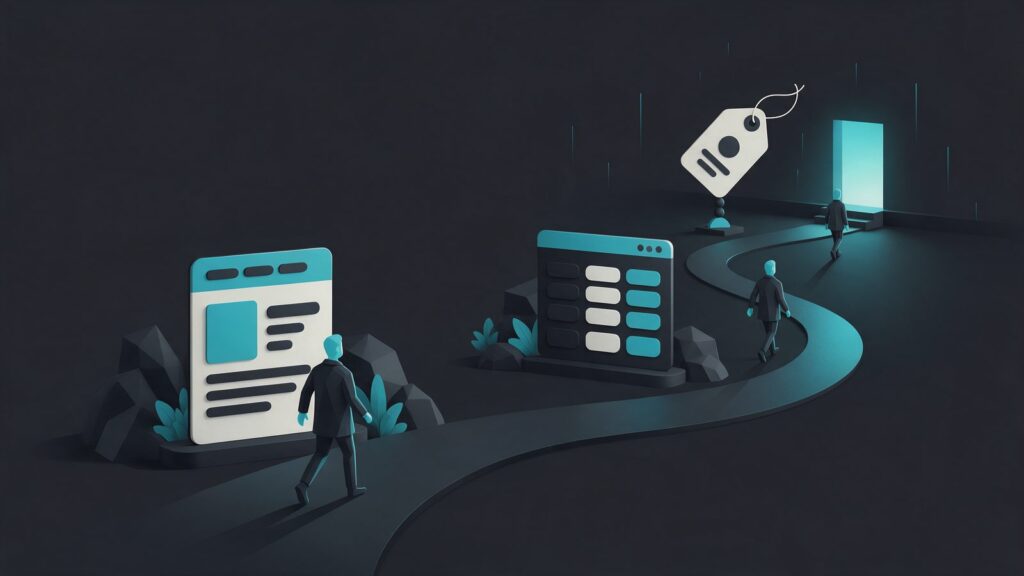
The buying journey is the path from noticing a problem to choosing who solves it. Content for the buying journey covers three stages: awareness, consideration and decision. With AI search, however, AI tends to answer the start of that path on its own. So your brand needs to appear in comparisons, pricing and alternatives.
In short
- The buying journey has three stages, but buyers move back and forth between them, according to Google.
- According to a content agency, AI answers definitions on its own. For recommendations, however, it names brands.
- In G2’s survey of B2B decision-makers, software buyers’ first AI prompt asks for a category in 33% of cases and names a competitor in 31%.
- The map is a table with a question, a stage and an owner page. So build it from the bottom up.
What is the buying journey and what are its stages?
The buying journey, which HubSpot calls the buyer’s journey, is the path a person takes until they buy. HubSpot, which sells marketing and sales software, describes three stages: awareness, consideration and decision. So the buyer first notices the problem, then weighs ways to solve it and finally chooses the provider.
According to HubSpot, the motivations, timelines and decision process change depending on whether the buyer is a consumer or a business decision-maker. Therefore, the stages of the buying journey carry different weight in B2B and in retail. So an online store’s map is not a template for a B2B company. B2B content marketing, for example, has its own questions, such as integrations and requirements.
Is the buying journey really a straight line?
No. In 2020, Google’s consumer research team, which sells ads, wrote that the path between trigger and purchase is not linear. Its model has two mental modes: exploring, which widens the options, and evaluating, which narrows them. Besides that, people switch between the two as many times as they need.
Google’s research looked at consumer purchases, such as retail and travel, and not at B2B buying. The page does not state the sample’s country. Still, the lesson applies to the map. It is not a sequence of posts but a list of questions that can come up in any order. Also, Google itself recommends that the brand be present while the person explores.
How does AI search change the buying journey?
According to G2, AI search compresses research: the buyer asks for a ready-made list and reaches the vendor with few names. G2 surveyed 1,076 B2B decision-makers, and 51% of the software buyers say they start researching more often with an AI chatbot than with Google. Even so, G2 reports that 80% use Google at some point in the purchase. In other words, the buying journey now has two entry points.
G2 surveyed buyers in March 2026 across North America, Europe, the Middle East, Africa and Asia-Pacific. It is a software review site and, for that reason, has an interest in the topic. Also, according to the company, 69% of software buyers said a chatbot led them to choose a different vendor than planned. Finally, G2 states that the first impression of a brand is increasingly formed inside the AI answer, before the visit to the website.
On the other hand, on the consumer side, Pew Research analyzed the browsing of 900 U.S. adults in March 2025. In visits to Google pages with an AI summary, 8% ended in a click on a traditional link. Without the summary, however, the rate was 15%. This is U.S. data from one online panel’s Google searches, which Pew does not present as representative of all searches. Therefore, it shows consumer searching, not B2B buying.
What does AI answer on its own, and where must your brand appear?
According to Grow & Convert, AI answers on its own what has the same answer in any source, such as definitions. On the other hand, it names brands when a person asks for a recommendation. Therefore, your brand needs to appear in answers about comparison, pricing, alternatives and use case, not in answers about definitions.
Grow & Convert, an agency that sells bottom-of-funnel content, has defended this order since 2018, with the method it called pain-point SEO. In its view, for a top-of-funnel search such as “what is content marketing”, AI has no reason to cite a company. After all, the information is the same in every source. In the agency’s experience, bottom-of-funnel searches convert 10 to 25 times better. However, this is an estimate from a company that sells the service, with no published method.
| Stage | What AI does on its own | Where your brand needs to appear |
|---|---|---|
| Awareness | Defines and explains the topic | A few guides that show command of the subject |
| Consideration | Compares approaches and criteria | How-to-choose guides and use cases |
| Decision | Recommends and compares vendors | Comparison, alternatives, pricing and case |
The table is our own reading, based on Grow & Convert and G2. After all, no study measures, stage by stage, what AI answers without citing a brand. In other words, the buying journey still has three stages, but your brand competes for the recommendation mostly in the last two.
Which questions do buyers ask AI first?
Evaluation questions, not definition questions. In G2’s data, the software buyer’s first prompt is about a category in 33% of cases and about a competitor in 31%. Next come requirements (22%), ecosystem (9%) and budget (6%). The percentages apply to software, but the pattern helps you imagine the questions in your own industry.
Grow & Convert adds that, in a conversation with AI, the person gives their own context, such as company size, budget and channels already tried. So, according to the agency, the most recommended companies will be those that say on their pages who they are best for. This is a prediction from a company that sells the service, not measured data.
What content should you make at each stage of the buying journey?
Make more decision and consideration content and less awareness content. At each stage of the buying journey, publish the format that answers the question of that moment. This way, content for the buying journey stops being a list of topics and becomes a list of answers that AI can use.
- Awareness, up to about 25% of each topic in the map: guides and definitions that show your brand knows the subject. So they build authority, not traffic.
- Consideration: how-to-choose guides, comparisons between approaches and use cases by segment. At this stage, the person has already defined the problem and, for that reason, weighs paths.
- Decision: a competitor comparison page, an alternatives page, a price range with what makes the price change, a case study and a list of integrations.
The 25% cap on awareness is our own rule, with no study behind it. However, the guide on how to do content marketing shows which content formats AI tends to cite for each type of question, using data from the Wix AI Search Lab study.
How do you build a buying journey content map, step by step?
Build content for the buying journey in six steps, from collecting questions to linking pages. So the result is a spreadsheet with one row per question, not a calendar of topics. This way, before writing any page, you see what exists, what is missing and where two pages would compete for the same search.
- List the pain points: gather questions from the sales team and support, Google autocomplete and “People also ask”. In Search Console, open the Queries tab of the performance report to see what people already type before reaching the site.
- Rewrite as a prompt: turn each pain point into the question the buyer would ask AI, that is, with industry, company size and budget.
- Sort by stage: awareness, consideration or decision in the buying journey.
- Give each question an owner page: this way, questions with the same answer stay on the same page. The guide on topic clusters shows how to keep two articles from competing for the same search.
- Prioritize from the bottom up: start with decision and consideration questions. Finally, leave awareness questions for later.
- Break decision questions into sub-questions: AI splits one question into several searches, and the query fan-out map helps you list them.
Content map template in a table
The template below is a buying journey content map in three columns. Each row links a question to one of the stages of the buying journey. Copy the table into a spreadsheet, delete the example rows and fill in your brand’s questions. The example is illustrative, for clinic management software, with no search volume data. In the spreadsheet, add columns for the URL, the owner and the review date.
| Buyer question | Stage | Owner page |
|---|---|---|
| What is an electronic medical record? | Awareness | Introductory guide |
| How to choose management software for a small clinic? | Consideration | Selection guide with criteria |
| Best management software for clinics | Decision | Category page |
| Alternatives to software X | Decision | Alternatives page |
| How much does clinic management software cost? | Decision | Pricing page |
| Management software for a physical therapy clinic | Decision | Use case by segment |
How do you know if the content map works?
Repeat the prompts for each stage of the buying journey every month and record whether your brand appears in the answer. Since AI changes its answer on every run, a single check proves nothing. The protocol of repeated prompts and margin of error is in the guide on how to measure brand visibility.
Review the map every quarter. In other words, cut the questions nobody asks anymore and merge the pages that compete for the same search. Then add the new questions from the sales team. The numbers in this guide describe buyer behavior along the journey, not the effect of the map. So avoid promising results: we found no independent study proving that mapping the buying journey increases AI citations.
Main sources
- HubSpot, what the buyer’s journey is and its three stages (2025).
- Think with Google, the “messy middle” of the purchase journey (2020).
- G2, survey of 1,076 B2B decision-makers on AI search (2026).
- Pew Research Center, clicks on links with and without an AI summary on Google (2025).
- Grow & Convert, bottom-of-funnel content in AI search (2026).
- Search Console Help, performance report (2026).