Reading time: 10 minutes
To train your agency team in GEO, we propose a 30-day plan split into four weeks: fundamentals, AI platforms, measurement and practice. This GEO training plan lists the official materials for each week, the exercises with the prompt list and the final assessment.
In short
- The GEO training plan, which is our recommendation, has four weeks, one per topic. Each week ends with a deliverable that the lead reviews.
- The materials come from the documentation of Google, OpenAI, Anthropic, Perplexity and Microsoft, plus two public studies.
- The exercises use the prompt list and the measurement protocol from our guides. So the team trains with the method it will apply to clients.
- The final test has three parts: ten questions, a mini-diagnosis of the agency’s own site and a one-page report.
What should a GEO training plan cover for the agency team?
To train your team in GEO, the plan covers four skills. First, know what GEO is and what it does not promise. Then understand how AI platforms find content, measure brand presence and apply the method. This scope works for people in SEO, content and account management, because each learns at their own level.
Before you start the GEO training, choose who leads it, such as the SEO lead. This person sets the meetings, reviews the deliverables and runs the final test. Also set aside one meeting of one hour per week, plus a few hours of individual study. However, this workload is our suggestion, so adjust it to the size of your team.
Use the agency’s own site as a lab. That way, nobody touches a client account while learning, and the learning becomes practice from day one.

What does the 30-day GEO training plan look like?
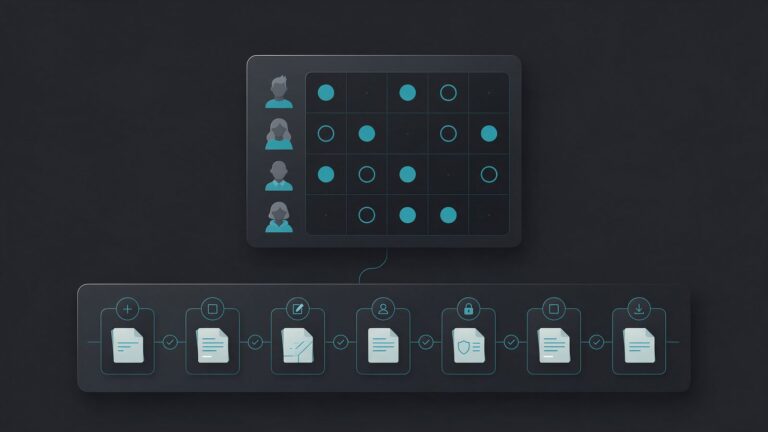
To train the team in 30 days, the GEO training plan uses four weeks. Each has a topic, study materials and a deliverable. The plan is our recommendation, has no research behind it, and is not an official course or certification. So the table sums up the calendar.
| Week | Topic | Deliverable |
|---|---|---|
| 1 (days 1 to 7) | Fundamentals and myths | GEO myths sheet |
| 2 (days 8 to 14) | AI bots and fan-out | robots.txt audit and subquestion map |
| 3 (days 15 to 21) | Measurement with prompts | Spreadsheet with 100 answers and presence rate |
| 4 (days 22 to 30) | Practice and final test | Mini-diagnosis and one-page report |
Week 1: what should the team know about GEO and SEO?
To train your team in GEO without myths, week 1 shows that, for Google, optimizing for generative AI search is still SEO. So the study, which separates what works from myth, starts from Google’s documentation and our GEO guide.
Study in this order:
- Google’s guide to optimizing for generative AI features: says that “AEO” and “GEO” describe AI visibility work and that, for Google, this is still SEO.
- AI features and your website: explains that a page must be indexed and eligible to be shown with a snippet to become a supporting link, with no extra technical requirement.
- What is GEO: the blog’s pillar, with the team’s vocabulary.
- GEO: Generative Engine Optimization: an academic paper that proposes the term. The authors report visibility gains of up to 40% on their own benchmark, with different effectiveness by domain. So the number is no promise to clients.
In the exercise, each person writes a myths sheet. It covers the five points the Google guide says to ignore: llms.txt, chunking content, rewriting only for AI, inauthentic mentions and overfocusing on structured data. But these points hold for Google, so week 2 brings the documentation from the other companies.
Week 2: which AI bots visit the site and what does each one do?
AI companies tend to split their bots: some train models, some feed search and some open a page at a user’s request. In week 2, the GEO training teaches how to tell these bots apart and what each robots.txt block does. So the list below sums up what the official pages say.
- Google: Googlebot crawls for Search, including the AI features, and its robots.txt is the site’s control.
- OpenAI: OAI-SearchBot shows sites in ChatGPT search, while GPTBot collects content that may train models. ChatGPT-User visits pages at the user’s request.
- Anthropic: ClaudeBot collects content that may train models, while Claude-SearchBot indexes content to improve search. Claude-User, in turn, fetches pages at the user’s request.
- Perplexity: PerplexityBot shows and links sites in search, while Perplexity-User visits pages at the user’s request.
Three warnings stand out. OpenAI says each setting is independent, so you can allow OAI-SearchBot and block GPTBot. Perplexity states that Perplexity-User, which serves a user request, generally ignores robots.txt. Anthropic warns that blocking Claude-SearchBot may reduce the site’s visibility in search.
In the exercise, the team opens the agency site’s robots.txt and notes, for each bot, whether it is allowed or blocked and what that does. Then compare the result with the robots.txt template for AI bots.
How does AI split a question, and what does Microsoft recommend?
According to Google’s guide, fan-out is the set of parallel, related searches the model generates to answer a question. To practice in the GEO training plan, each person takes a prompt from the list. Then they write the subquestions the AI would ask, using the method in the guide to query fan-out. However, Google warns that creating a page for each variation mainly to manipulate responses violates its scaled content abuse spam policy.
Meanwhile, Microsoft Advertising, which sells ads, recommends clear titles, headings, direct answers to questions and lists or tables.
Week 3: how do you practice measurement with the prompt list?
In week 3 of the GEO training plan, each pair runs the 20 base prompts from our list, 5 times each, on one engine. Then they calculate the brand’s presence rate. After all, the goal is to practice the protocol and feel the variation between answers, not to prove a trend.
First, read the SparkToro study. In it, 600 volunteers ran 12 prompts on ChatGPT, Claude and Google’s AI, for a total of 2,961 runs. As a result, for ChatGPT and Google’s AI, the chance of two answers giving the same list of brands was below 1 in 100. The tools are the most popular in the US, and each volunteer kept their own settings. Also, SparkToro sells software, and the research partner works at an AI tracking startup, which the author discloses.
Then follow these steps:
- First, choose the brand for the GEO training plan exercise, preferably the agency itself.
- Next, adapt the 20 base prompts from the list of prompts to track the brand to the market.
- Run each prompt 5 times, in a new chat and without personalization, as the measurement protocol says.
- Then log each answer: date, engine, prompt, run, brand named, site cited and competitors.
- Calculate the presence rate, that is, the answers with the brand divided by the total, times 100.
- Then repeat 5 prompts on another day and compare the brand lists.
- Finally, note what changed between the two rounds.
With 100 answers, the margin of error is larger than the ± 6 to ± 14 points that the protocol calculates for 250. So, in the GEO training plan, treat the number as practice, not as a result.
Which free reports does the team learn to read?
At the same time, the GEO training has the team read three free sources, because each shows a piece of the picture. The generative AI performance report, in Search Console, shows impressions in AI Overviews and AI Mode, by page, country, date and device. Google’s help page says that, as of August 31, 2026, the report had been rolled out to all websites worldwide. Sites with few impressions may not see data.
AI Performance, in Bing Webmaster Tools, arrived in February 2026 as a public preview. So it shows citations by page in Copilot and in Bing’s AI summaries. Finally, GA4 shows visits from AI assistants.
Week 4: how do you apply the GEO training plan to a real site?
To train your team in GEO in practice, week 4 of the GEO training plan brings everything together in a mini-diagnosis of the site and a one-page report. It answers three questions: do the bots reach the site, does the AI cite the site and what does the team fix first.
- Access: first, check that the bots are allowed in robots.txt. Also check that the main pages are indexed and eligible to be shown with a snippet, Google’s technical requirement.
- Presence: next, use the week 3 rate and list the sources the AI cited in the answers.
- Content: pick three pages with their own point of view and three that only repeat what already exists on the web. According to Google, unique and useful content will likely influence, in the long run, presence in generative AI search more than the other tips in the guide.
- Priority: finally, choose up to three fixes and, for each, cite the official source that supports it.
The one-page report of the GEO training plan uses the protocol’s blocks: visibility, competition, authority, reputation, traffic and Google and Microsoft data. It also shows the margin of error and does not promise a position in the answers. After all, Google warns against third-party tools that promise ranking success, because none has access to its internal systems.
How do you assess the team at the end of the GEO training plan?
After the GEO training plan, the team takes three tests: ten questions on the materials, the mini-diagnosis and a ten-minute presentation of the report, with the lead playing the client. Set the passing score before you start. That way, nobody negotiates the criterion later.
| Test | Pass when |
|---|---|
| Questions | The person gets 8 of 10 (a score we suggest) |
| Mini-diagnosis | Each fix cites an official source and the collection follows the protocol |
| Presentation | The report shows the margin of error and does not promise a position |
After the test, the next step is to build a GEO service at the agency.
What questions go in the test?
Here are five examples, and the answers come from the materials in each week:
- Does the site need llms.txt to appear in AI Overviews? No, because Google says Search does not use that file.
- Does blocking GPTBot remove the site from ChatGPT search? No, because search depends on OAI-SearchBot and the settings are independent.
- Which Perplexity bot serves user requests? Perplexity-User, which generally ignores robots.txt.
- Why does a single check not measure visibility? Because answers vary: in the SparkToro study, the chance of ChatGPT or Google’s AI repeating the same list of brands was below 1 in 100.
- What is query fan-out? That is, the parallel, related searches the model generates to answer the question.
How do you keep the team up to date after the GEO training plan?
The GEO training plan does not end on day 30, since platform documentation changes. So schedule a review each quarter: reread the official pages and fix the myths sheet. Then repeat the collection with the same prompt list. That way, you train your team in GEO as a routine, not a one-time event.
Main sources
- Google Search Central, guide to optimizing for generative AI features in Google Search (2026).
- Google Search Console, generative AI performance report (2026).
- OpenAI, overview of OpenAI crawlers (2026).
- Anthropic, Anthropic bots and how to block them (2026).
- Perplexity, Perplexity crawlers (2026).
- Bing Webmaster Blog, AI Performance in Bing Webmaster Tools (2026).
- SparkToro, study on how inconsistent AI brand recommendations are (2026).
- arXiv, GEO: Generative Engine Optimization (2024).