Reading time: 11 minutes
Franchise SEO, also called SEO for franchises, makes each of your franchise locations show up, with correct data, on Google, Maps and local AI answers. So every store needs its own verified profile, page and reviews. At the same time, every store must say the same thing about the brand.
In short
- AI recommends locations, not brands. In a SOCi study of 2,751 multi-location brands, ChatGPT recommended only 1.2% of the locations analyzed.
- Google lets you verify profiles in bulk and group them. But all franchise locations need their own profile, with a unique code in the spreadsheet.
- All franchise locations use the same name and category. The phone number and website on each profile should belong to that location.
- Google bans review quotas for staff. So ask every customer for a review and track replies store by store.
How does AI choose between franchise locations of a chain?
In our reading, AI answers by city and neighborhood, not by brand. For a request like “gym in Austin”, it names a few options near the user. So in a chain with 80 stores, each location competes alone in its own area. A location with an incomplete profile, therefore, tends to vanish from the answer, even when the brand is strong.
The size of the sector shows why this matters. According to the International Franchise Association, the US had 832,521 franchise establishments in 2025, and the study, run by FRANdata, projects 845,000 for 2026. The IFA is a franchise trade association, and the release doesn’t describe its data sources.
The contest in AI is also much tougher than on the Google map. In the SOCi index of more than 350,000 locations across 2,751 multi-location brands, ChatGPT recommended only 1.2% of locations. SOCi sells local marketing software to multi-location brands, and its January 2026 release doesn’t state the countries covered or the collection period. The other numbers and the method are in the guide to GEO for local business.
Where does the data come from? Google’s guide to generative AI says Google Business Profiles help products and services appear in AI answers. OpenAI, for its part, says it may share location with third-party providers of local information, and it does not name them. So franchise SEO works the same three fronts in every store: profile, website and reputation. If GEO is new to you, start with the guide on what GEO is. For the Gemini app, see how Gemini uses Google Maps.
How do you verify dozens of franchise locations on Google at once?
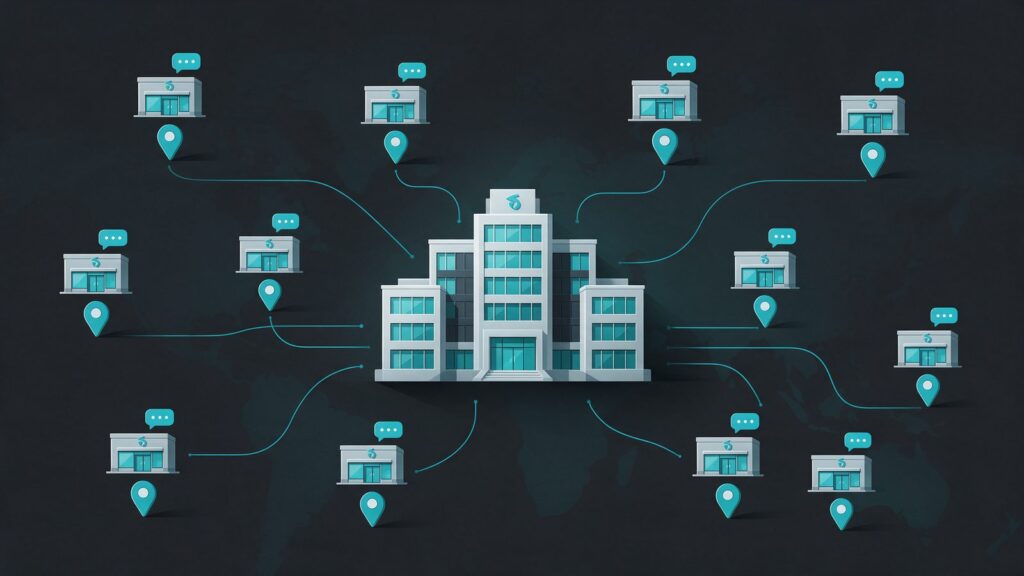
Google offers bulk verification for businesses with 10 or more franchise locations. First, the chain creates a business group. Next, it uploads a spreadsheet with all franchise locations, fixes the errors and requests verification in the Business Profile Manager. The minimum and the limits are in the local SEO guide.
According to Google’s help page on business groups, a business group works like a shared folder of profiles. Anyone added as an owner or manager of the group can open all current and future profiles in it. Google recommends one group per business or brand. But if the organization has brands with different teams, it can create several groups.
In the bulk upload spreadsheet, each location needs a business code. The code is unique, has up to 64 characters and does not show on Google. In other words, it is the key the chain uses to find each store in every update.
Verification, however, is not permanent. As the bulk verification help page explains, Google may de-verify accounts that don’t actively manage their profiles. Also, a profile verified by someone else, such as a former franchisee, joins the account only through an access request. So in SEO for franchises, the account needs someone who reviews the profiles every month.
How do you stop AI from mixing up location data?
AI mixes data when stores show different names, phones or hours in each source. So the rule is a single base, from which profiles, website and directories come. On Google, the guidelines ask for the same name across all locations in the country, with exceptions such as sub-brands, and the same category for the same service.
The Business Profile guidelines give US examples. A store is “Apple Store”, not “Apple Store at Stanford Shopping Center”. A store code is also banned from the name: “The UPS Store” is fine, but “The UPS Store – 2872” is not. On the other hand, an authorized and fully dedicated seller of a brand may use the brand name, as in “U-Haul Neighborhood Dealer”.
The same guidelines ask for a phone number or website specific to the location. Whenever possible, the number should be local, not a call center line. In practice, then, each store’s profile points to that location’s page.
We recommend a master spreadsheet with one row per store:
| Field | Who sets it | Where it appears |
|---|---|---|
| Name and category | HQ | Profile, site and directories |
| Address and phone | Location, with approval | Profile, page and directories |
| Hours and holidays | Location | Profile and page |
| Business code | HQ | Spreadsheet only |
When a store moves, the chain updates the row and copies the change to every source the same day. After all, the spreadsheet only works as the single source. SEO for franchises depends on this discipline, because AI cross-checks the profile against the website and directories.
Does a page per location help franchise SEO?
It helps, as long as each page belongs to a real store, with that store’s data and content. The page is the target of the profile link, and it gives AI its own source about the franchise location. But several city pages that send users to the same destination, with no store in the city, fall under Google’s spam policy on doorways.
For franchise SEO, we recommend that each page for franchise locations include:
- Profile data: name, address, phone and hours, identical to the master spreadsheet.
- What only that store does: services, parking, payment methods and staff.
- How to get there: neighborhood, landmarks and transit.
- Reviews and questions: the doubts customers in that area ask.
The store locator also matters. According to Google Search Central, Google can generally crawl a link only when it is an HTML element with an href attribute. In our reading, a locator that is only a search box may hide the location pages. So also build a list of stores by state and city, with plain links.
The policy against city pages with no store is in the local business guide linked above. In sectors such as healthcare, advertising rules change what the page may say, as the guide to GEO by industry shows.
How do you manage reviews in SEO for franchises?
Each location collects its own reviews, and, in our reading, AI weighs reputation store by store. So the chain asks every real customer for a review and replies to all of them, in every location. However, Google bans asking only happy customers and giving staff a review quota.
The Google Maps content policy lists what a merchant may not do:
- offer payment, discounts or freebies in exchange for a review;
- discourage negative reviews or ask for positive ones selectively;
- ask staff to collect a set number of reviews;
- ask for reviews with specific content, such as an employee’s name.
Reviews from employees and former employees also count as a conflict of interest. For that reason, a contest between stores for the most reviews pushes staff toward what the policy bans. In franchise SEO, then, stores should compete on the quality of their replies, not on volume.
For SEO for franchises, we recommend goals that each location controls: reply within two business days, reply to negative reviews too and fix the problem behind the complaint. HQ, for its part, sets the tone and the reply templates. That way, replies sound like one brand but address each store’s case.
Who handles franchise SEO: HQ, the franchisee or the agency?
HQ handles what must be identical in every store, and the franchisee handles what changes day to day. The agency, when there is one, works both sides with access granted by HQ. Google allows this split through the owner and manager roles.
According to Google’s help page on owners and managers, each profile can have several owners but only one primary owner. The manager has almost the same access. The only exceptions: managers can’t add or remove users, and they can’t remove the profile. In other words, a manager can also change the name, category and website.
So we recommend this split:
| Task | Who does it | Google access |
|---|---|---|
| Name, category and site | HQ | Primary owner |
| Hours, photos and posts | Franchisee | Location manager |
| Review replies | Franchisee, to HQ standard | Location manager |
| Users and profiles | HQ | Owner |
| Tracking by city | HQ or agency | No profile access |
Since a manager can edit the name, the rule must be written in the chain’s marketing manual. Likewise, HQ reviews the profiles every month and reverts changes that break the standard. The franchisee joins as manager of their own store’s profile only, not of the whole group. That way, they can’t edit other franchise locations.
When you pick a marketing agency for franchises, ask whether it works with business groups, spreadsheets and a code per store. After all, SEO for franchises across dozens of franchise locations can’t be done profile by profile.
How do you track franchise SEO by city in AI answers?
Track with a fixed list of requests per city, repeated every month, in each area where the chain has a store. Then record whether the location appears, which competitor appears instead and which sources AI cites. Brand presence nationwide, on its own, hides the cities where the chain disappears.
Location changes the answer. According to the OpenAI Help Center, ChatGPT may use an approximate location, based on your IP address, to give relevant local results. So we recommend putting the city and neighborhood in the request itself, such as “best gym in Wicker Park” (a Chicago neighborhood). Otherwise, the tests tend to reflect the IP of the HQ office.
For each city, we recommend tracking:
| Metric | What it shows |
|---|---|
| Location presence | Whether the store enters the answer |
| Competitor in its place | Who AI names when the store drops out |
| Cited sources | Where AI got the information |
| Wrong data | Swapped address, phone or hours |
With these metrics, HQ learns where to act first. For example, a city with wrong data needs a fix in the spreadsheet. A city with no presence and a correct profile needs reviews and local content. The number of requests and repeats follows the protocol in how to measure brand mentions and citations. With dozens of cities, however, manual collection stops scaling. At that scale, SEO for franchises needs a tool that fixes the city of each test. To choose what goes into the board report, see the GEO metrics for the report.
Frequently asked questions
Yes, but the profile must use the brand name and follow the chain’s standard. Google’s guidelines allow an authorized and fully dedicated seller of a brand, which covers a typical franchisee, to use the brand name. For bulk verification, however, HQ must request access to profiles verified by someone else. So agree in the contract who will be the primary owner.
Yes, but it must verify profiles one by one, because Google’s bulk verification requires 10 or more locations of the same business. The other rules apply equally: the same name, the same category, a phone and site for each location and a page per real store. A business group, in turn, already helps from 2 profiles.
It is not a good idea. Google Maps policy bans merchants from asking staff for a set number of reviews, and it bans incentives in exchange for reviews. So the safe goal for chains is about replies: answer every review, negative ones included, in every location.
Main sources
- Google Business Profile Help, Verify Business Profiles in bulk (2026).
- Google Business Profile Help, Create and manage business groups (2026).
- Google Business Profile Help, Guidelines for representing your business on Google (2026).
- Google Business Profile Help, Manage owners and managers of a Business Profile (2026).
- Google Maps Help, Prohibited and restricted content (2026).
- International Franchise Association, 2026 Franchising Economic Outlook, by FRANdata (2026).
- SOCi, Local Visibility Index 2026 press release (2026).